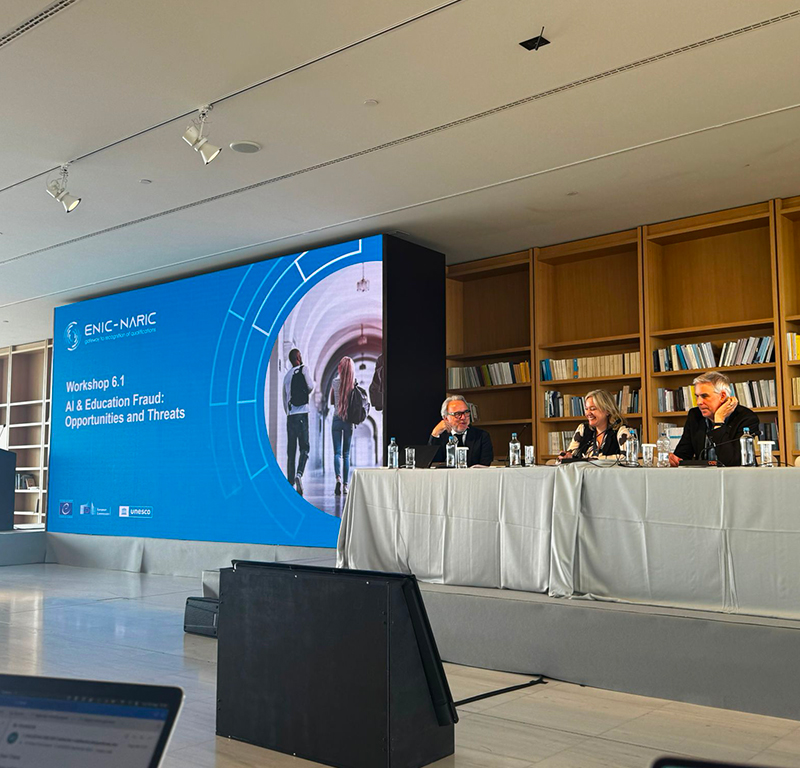
On 25 May 2026, at the 33rd ENIC-NARIC meeting in Athens, the Centre for Preventing and Countering Education Fraud was presented during the workshop “AI & Education Fraud: Opportunities and Threats”. The workshop, attended by 71 participants representing ENIC-NARICs and international experts, addressed the growing impact of Artificial Intelligence (AI) on education fraud, with a specific focus on verifying the authenticity of academic qualifications.
The workshop combined policy overview, research perspectives and practices with a panel discussion chaired by Villano Qiriazi (Council of Europe) featured contributions from Phil Newton (Swansea University) and Elisa Petrucci (CIMEA, ENIC-NARIC Italy).
Three core pillars guided the workshop’s activities:
- The role of instruments and actions developed by the Council of Europe to support integrity and transparency in education, in complementarity with existing initiatives on the topic.
- The role of higher education institutions in assessing competencies acquired by learners in the AI era.
- The Centre for Preventing and Countering Education Fraud and its synergy with the projects Fraud-Act and Verify-AI.
Valuable insights were gathered from the speakers, including the importance of:
- The ETINED Platform for sharing knowledge, information and good practices among experts in the domain of education fraud appointed by Member States.
- The questions raised by the potential use of AI in online unsupervised exams and how to make an assessment effective, including design principles that can strengthen reliability and security.
- The four pillars of the Council of Europe 2022 Recommendation on countering education fraud: preventing, prosecuting, monitoring and international cooperation.
- Structured data for monitoring education fraud and how this could help to draw up a data-driven roadmap for the Centre for Preventing and Countering Education Fraud, grounded in the experience of the Fraud-Act project.
- Digital transformation and the use of AI, not intended as the mere application of digital tools to analogue processes. It requires the reengineering of the entire recognition workflow to make it truly digital. As shown in the preliminary results of the white paper on AI in recognition, currently under development within the Verif-AI project, this is a fundamental element.
Thanks to the interactive session, participants had the chance to highlight the relevance of AI in supporting some steps of the recognition process, in particular on document checks and authenticity verification. However, it was underlined that human oversight is still regarded as the main underpinning principle.
Finally, cooperation, training and information sharing were identified as the key drivers for enhancing the role of ENIC-NARIC centres in tackling education fraud.
For more information, visit the Council of Europe website.